

Africa's cross-border payment market processes roughly $48 billion annually, and the average transaction still costs 8 to 10 percent of its value — nearly double the global average, according to World Bank data. That gap is not an accident. It is the direct result of 54 countries, 42 or more currencies, and dozens of central bank jurisdictions that have never been stitched into a single coherent financial layer. Every business that expands across African markets eventually discovers the same thing: the banking decision they made before they launched is actually the market access decision they made before they launched.
Most businesses do not treat it that way. They choose a banking partner the way they choose an accounting firm — necessary, but secondary. Then they spend the next eighteen months fighting FX volatility, stalled onboarding, failed settlement, and payment rails that simply do not reach the customers they came to serve. The infrastructure problem arrives dressed as an operational problem, and by then, the cost of switching is high.
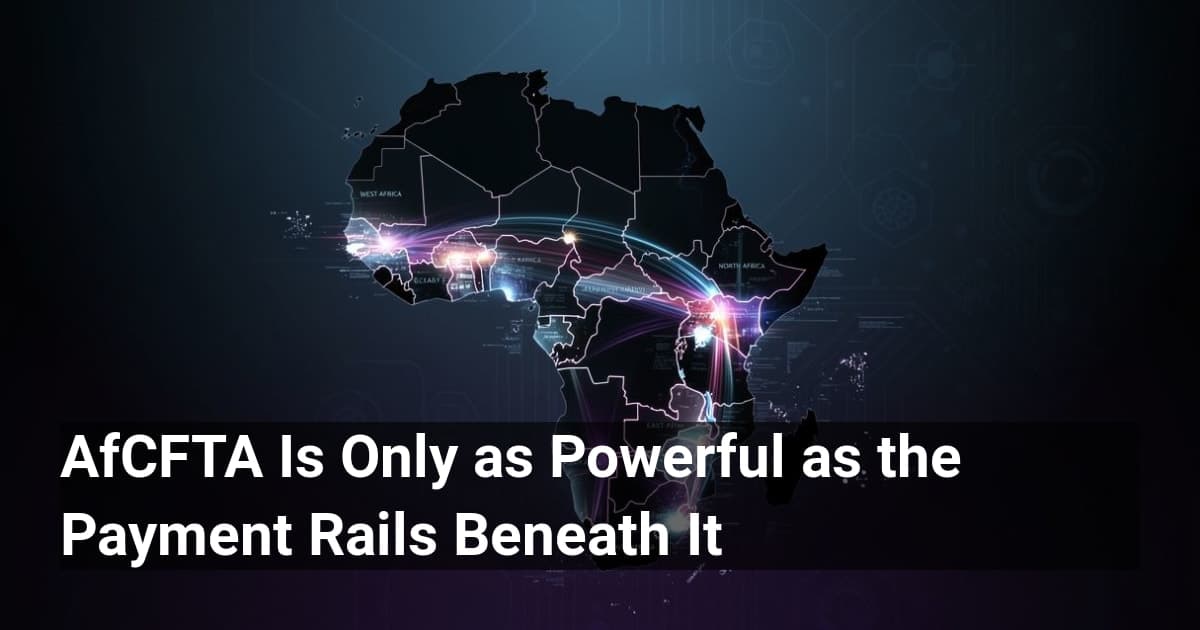
The African Continental Free Trade Area has changed the stakes. With 47 countries now ratified, AfCFTA is projected to push intra-African trade from its current 15 to 17 percent of total African trade — compared to 68 percent within Europe — to over 52 percent by 2030, according to the African Development Bank. Businesses that have not built multi-country banking infrastructure are not just moving slowly. They are structurally excluded from the world's largest free trade area by country count.
Legacy Banks vs. Fintech Rails: A False Binary
The instinct when expanding across Africa is to anchor with one of the established pan-African banks. Ecobank operates in 36 African countries — the largest footprint of any bank on the continent. UBA and Access Bank cover 20 countries each and have been pushing further, opening offices in the UK, US, and France to serve diaspora corridors and trade routes. Standard Bank and Equity Bank round out the group of institutions that can credibly claim regional scale.
These banks carry real advantages. They have regulatory relationships in markets where a new entrant would spend years building trust. They have balance sheet depth that enterprise treasury operations require. For a business moving large volumes across borders, or one that needs to hold significant local currency positions, a banking license matters. A fintech cannot always substitute for that.
But the gap shows up quickly on the product side. Traditional pan-African banks have been slow to build API-first infrastructure, slow to digitise onboarding, and slow to create developer experiences that allow a business to integrate banking functionality directly into its own product. That is not a criticism — it reflects the structural priorities of institutions built around branch networks and relationship banking. It is simply a constraint that product-led businesses run into fast.
On the other side, fintech infrastructure players — Flutterwave, Paystack, Chipper Cash, Nala — have built real-time, API-first cross-border rails that legacy banks cannot match in speed or developer experience. Fintech investment in Africa reached approximately $3.3 billion in 2022, with cross-border payments and embedded finance attracting the largest share, according to TechCabal and Disrupt Africa. The market has already validated these rails. The limitation is the other direction: fintech infrastructure players do not hold full banking licenses, and they do not carry the balance sheet depth that large-volume treasury operations demand. They are excellent at moving money. They are not yet banks.
The businesses that get this right are not choosing one or the other. They are building a layered approach — and the quality of that layer depends entirely on how clearly they understand the criteria.
A Framework for the Decision
There are five areas where the choice of banking partner creates direct operational consequences. Each one is worth pressure-testing before signing anything.
Regulatory coverage and compliance depth
Operating in multiple African markets means operating under multiple central bank regimes, each with its own capital controls, reporting requirements, and licensing frameworks. A banking partner's regulatory footprint is not just a map of where they have branches — it is a map of where they can actually help you stay compliant. A partner that covers 20 countries on paper but has thin compliance infrastructure in half of them is not a 20-country partner. Ask specifically about in-country compliance support, not just country presence.
API connectivity and digital onboarding
If your product collects revenue, pays suppliers, or manages disbursements programmatically, your banking partner's API quality is a core product dependency. The speed at which you can onboard, integrate, and go live in a new market is determined here. Legacy banks have been improving, but the gap with fintech-native infrastructure remains significant in most markets.
Mobile money integration
Sub-Saharan Africa accounted for 57 percent of the world's mobile money transactions in 2022, with over $832 billion processed, according to the GSMA State of the Industry Report 2023. There are over 781 million mobile money accounts in the region. M-Pesa, MTN MoMo, Airtel Money, and Wave are not alternative payment methods in East and West Africa — they are the dominant payment rail. A banking partner that cannot connect to these ecosystems is not offering you access to the market. It is offering you access to a fraction of it.
FX tools and multi-currency support
Africa's 42-plus currencies include many with capital controls, thin liquidity, and significant volatility. A banking partner that only offers USD and EUR corridors is solving the easy problem. The real question is whether they can hold and settle in local currencies, whether they offer FX hedging tools, and whether they have liquidity in the corridors that actually matter for your specific markets — not just the major ones.
Local support and onboarding speed
When a payment fails in Nairobi at 11pm, or a compliance query comes in from a central bank in Accra, the quality of your banking partner's local team is the difference between a resolved issue and a frozen account. Relationship banking still matters in Africa, even when the infrastructure is digital. The businesses that underestimate this tend to find out the hard way.
Where the Gaps Live
No single institution currently covers all five criteria at the same quality level. The legacy pan-African banks are strongest on regulatory coverage and balance sheet depth. The fintech rails are strongest on API connectivity, mobile money integration, and onboarding speed. The FX tools picture is uneven across both categories. Local support quality varies more by country than by institution type.
This is the structural reality that Mydappr is built to navigate. The role we play is not to replace a banking partner — it is to sit between a business's product and the fragmented pan-African banking ecosystem, translating the complexity into infrastructure that works. The businesses we work with are not looking for a single answer to the banking question. They are looking for a layer that connects the right partners, covers the right markets, and keeps the product moving while the compliance and treasury pieces are handled by institutions built for exactly that. That is what digital rails actually mean in practice — not a single pipe, but the architecture that makes the right pipes available at the right moment.