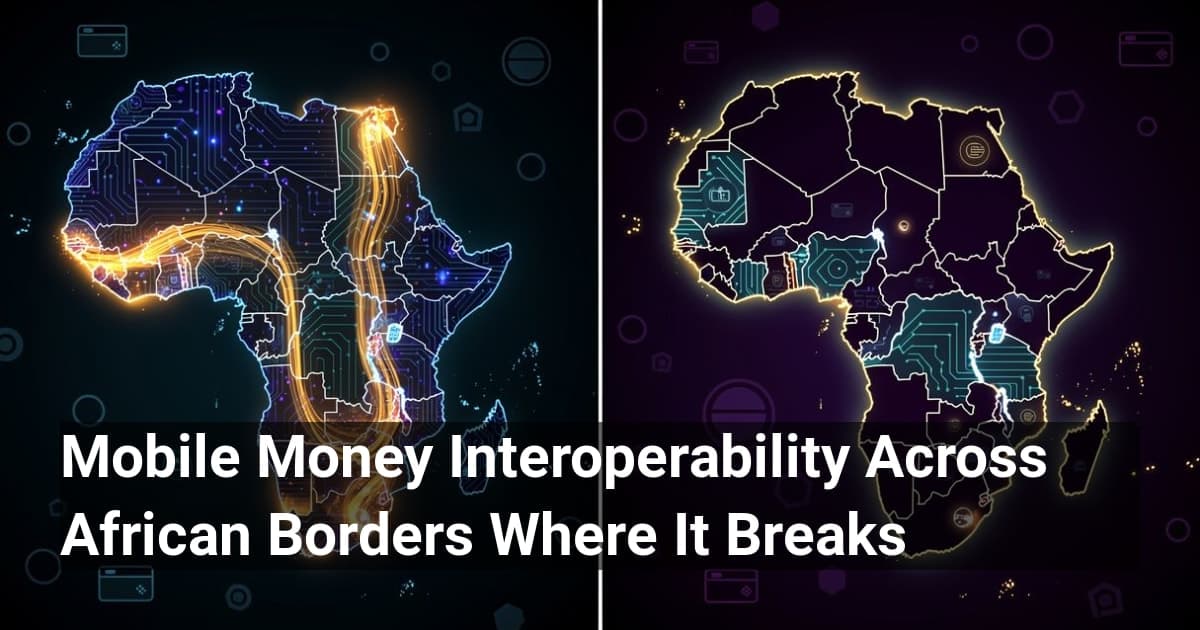

Africa processed approximately $912 billion in mobile money transactions in 2023. That number, from the GSMA's State of the Industry Report, gets cited often — usually as proof that the continent has figured something out. And in one sense, it has. Mobile money adoption here is not an experiment. It is daily infrastructure for hundreds of millions of people.
But here is the number that does not get cited as often: only an estimated 5–7% of those transactions cross a border. In a continent of 54 countries, with intra-African trade growing under the African Continental Free Trade Area, fewer than 40 active cross-border mobile money corridors exist globally — and the ones that work are concentrated in East Africa, between Kenya, Tanzania, Uganda, and Rwanda. A trader in Lagos trying to pay a supplier in Accra using mobile money will hit friction that has nothing to do with technology and everything to do with infrastructure that was never built.
That gap is not an accident. It is the predictable result of building payment systems country by country, operator by operator, without a connective layer underneath. The mobile money accounts exist. The wallets exist. The users exist. What does not exist — not at scale, not reliably — is the rails that let those systems talk to each other across borders.
What Works, and Why It Doesn't Scale
The East African corridor is the closest thing Africa has to a working model of cross-border mobile money interoperability. Bilateral agreements between specific operators — MTN and Airtel in various combinations, M-Pesa's links across Kenya, Tanzania, and Uganda — mean that some transfers between those countries work without routing through a bank. That is real progress. It took years of commercial negotiation, regulatory alignment, and technical integration to get there.
The problem is that it does not scale. A bilateral deal between two operators in two countries is not infrastructure. It is a handshake. Replicate it across 54 countries and thousands of operator pairs and you have not built a system — you have built a web of individual agreements that breaks the moment one party changes its terms, its technology, or its compliance posture. As TechCabal and Techpoint Africa have both reported, even within regional blocs like ECOWAS and the East African Community, interoperability is inconsistent. The regional framework exists on paper. The payment reality on the ground is patchwork.
The most ambitious attempt to fix this at the continental level is the Pan-African Payment and Settlement System — PAPSS — launched by Afreximbank and the African Union. PAPSS went live in 2022 and by 2024 had onboarded central banks and commercial banks across several African markets. Its core proposition is sound: enable instant cross-border payments in local currencies, cutting out the US dollar as an intermediary and reducing the cost and delay that correspondent banking adds to every transaction. For a continent where the average remittance cost runs between 7–9% of transaction value — nearly double the UN SDG target of 3%, and above the global average of roughly 6.4% — that proposition matters enormously.
Why PAPSS Alone Cannot Close the Gap
PAPSS is necessary. It is not sufficient. Transaction volumes through the system remain a fraction of Africa's cross-border payment flows, which the research estimates at over $5 billion annually. The reasons are structural and worth naming clearly.
First, regulatory fragmentation. Fifty-four countries means fifty-four licensing regimes, fifty-four sets of KYC and AML requirements, and fifty-four central banks with their own rules about transaction limits, reporting obligations, and what constitutes a compliant payment. A transfer that clears compliance in one jurisdiction can be flagged or blocked in the next. No single institution — not PAPSS, not any regional body — has the mandate or the speed to harmonise all of that. It is a multi-decade policy project dressed up as a payment problem.
Second, operator onboarding. PAPSS connects banks and central banks. The mobile money ecosystem is dominated by telco-owned wallets — MTN Mobile Money, Airtel Money, M-Pesa — that operate outside traditional banking rails. Connecting those wallets to a bank-centric settlement system requires integration work that most telcos have not prioritised, and commercial agreements that have not been struck.
Third, currency convertibility. Settling in local currencies is the goal. But many African currencies have thin FX markets, capital controls, or convertibility restrictions that make real-time settlement genuinely hard. The dollar intermediary that PAPSS is trying to remove is expensive and inefficient — but it is also, in many corridors, the only liquid option available today.
The Last-Mile Problem Nobody Is Solving at Infrastructure Level
Startups have moved into the gap. Chipper Cash, Nala, and Leatherback are all building cross-border payment products that serve real users. They are doing important work. But none of them are building infrastructure-level interoperability. They are building on top of the same fragmented rails — using correspondent banking relationships, FX conversion layers, and bilateral integrations — and absorbing the cost and complexity themselves. That makes them products, not rails. When their unit economics tighten, the cost gets passed to users or the service gets restricted to corridors where margins hold.
The actual infrastructure gap is an API layer — something that sits between existing wallets, banks, and fintechs and handles the compliance translation, FX settlement, and routing logic so that any operator can connect to any other without rebuilding that stack from scratch. Right now, every player who wants to offer cross-border payments builds their own version of this. The duplication is enormous. The inconsistency is the user's problem.
The World Bank's estimate is that reducing remittance costs to sub-3% could unlock billions in economic value annually across the continent. That is not a fintech opportunity in the conventional sense — it is not about acquiring users or building a better app. It is about whether the underlying infrastructure can make the cost of moving money across African borders reflect the actual cost of moving money, rather than the cost of navigating a system that was never designed to connect.
Mydappr is building the connective tissue — the interoperability rails that let existing wallets, banks, and fintechs route cross-border payments without each one rebuilding compliance, FX, and settlement infrastructure independently. The mobile money accounts are there. The trade flows are there. What Africa's payment ecosystem needs now is not another wallet. It is the layer underneath that makes all the wallets work together.