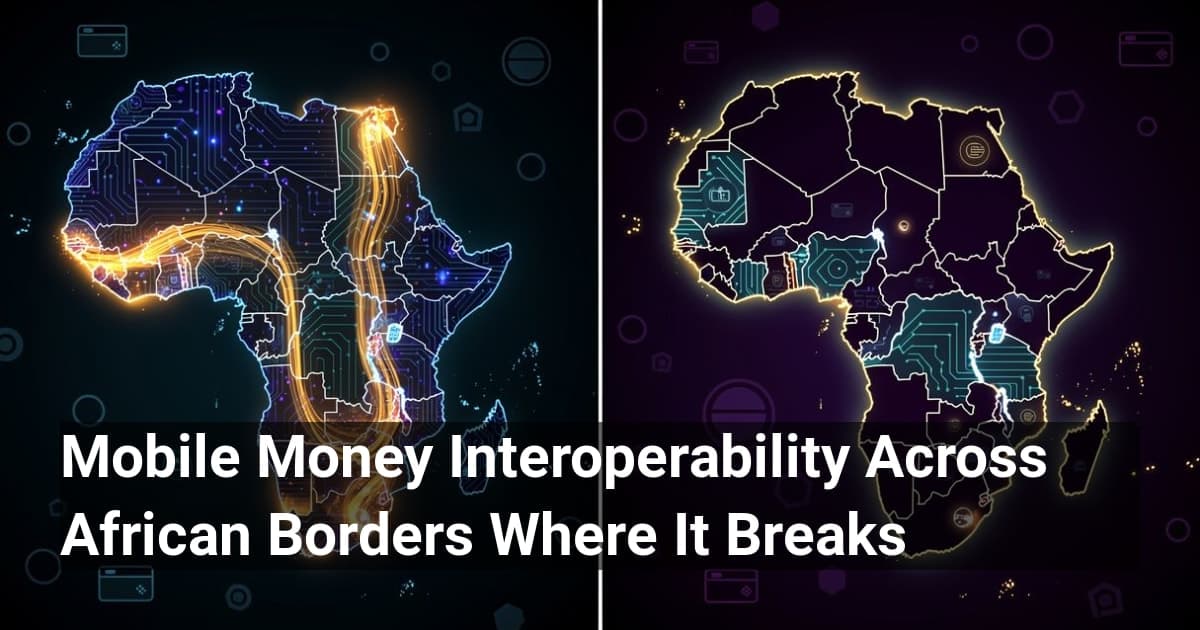

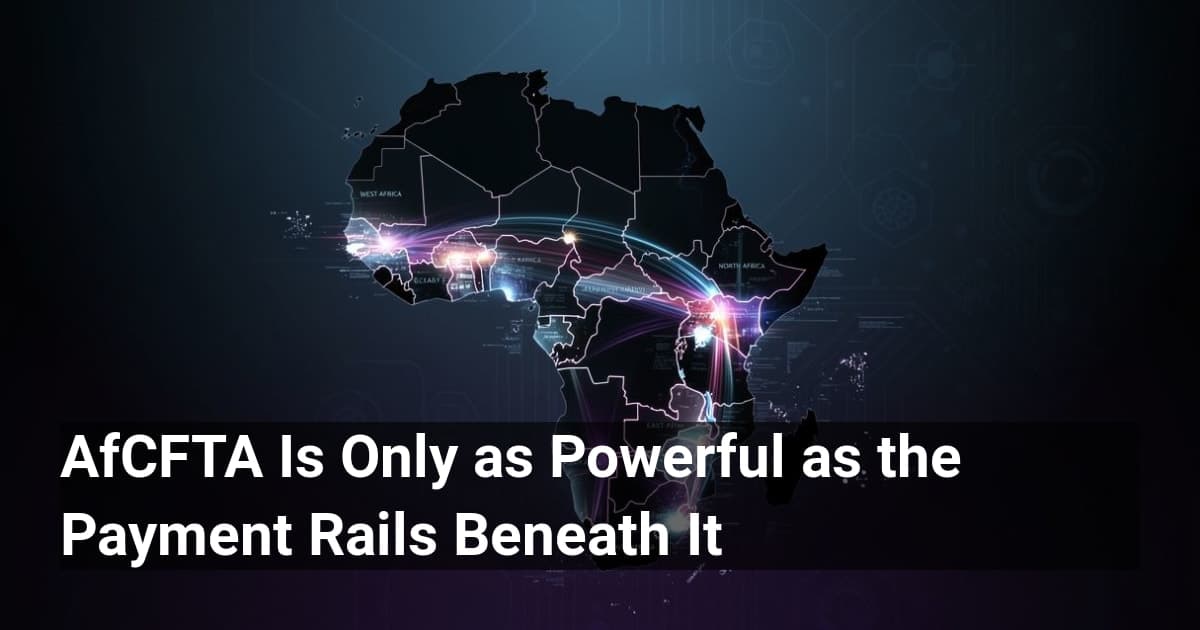
Intra-African trade sits at roughly 15% of Africa's total trade volume. Europe moves at 60%. The gap is not explained by what African countries make or grow or build. It is explained, in large part, by what happens when a business in Accra tries to pay a supplier in Nairobi — the money leaves the continent, touches a correspondent bank in New York or London, absorbs a fee averaging 7–9% of the transaction value, and arrives days later. That is not a trade policy failure. That is an infrastructure failure dressed up as one.
AfCFTA — the African Continental Free Trade Area, now covering 54 of 55 African Union member states and in force since 2021 — is rightly understood as the most ambitious trade liberalization project in African history. The targets are serious: boost intra-African trade to 52% of total trade by 2035, which implies payment infrastructure capable of handling an estimated $450 billion or more in additional annual transaction volume. Most coverage of AfCFTA stops at the tariff schedules and rules of origin. That framing misses the actual constraint. You can eliminate every tariff on the continent tomorrow and the 7.9% average cost of moving money across African borders — nearly double the UN's own SDG target of 3% — will still choke the trade that was supposed to flow.
The free trade agreement, on its own, is the political permission slip. What makes it real is the payment rail. And that rail now has a name.
PAPSS and What It Actually Does
The Pan-African Payment and Settlement System — PAPSS — was developed by Afreximbank in partnership with the AfCFTA Secretariat and went live commercially in 2022. The architecture is straightforward in principle and genuinely difficult in execution: enable businesses to transact across African borders in local currencies, in real time, without routing through USD or EUR correspondent banking intermediaries. As of 2023–2024, PAPSS has onboarded over 14 central banks and is processing transactions across multiple corridors. Afreximbank estimates that at scale, PAPSS could save Africa up to $5 billion annually just by eliminating the unnecessary legs those New York and London correspondent banks currently extract fees from.
For a developer or a founder building a cross-border commerce product, PAPSS is not an abstract policy instrument. It is an emerging settlement backbone — the layer beneath the layer. It means that a payment initiated in CFA francs and received in Kenyan shillings does not need to be converted to dollars twice and taxed twice in the process. The plumbing changes. And when the plumbing changes, what you can build on top of it changes.
The Private Rails Running Alongside
PAPSS is the official infrastructure layer. But the builders who have been working this problem for years — Flutterwave, MFS Africa (now part of DPO Group), Onafriq — are not waiting for central bank onboarding timelines to catch up with market demand. They have been constructing multi-currency, multi-corridor payment networks that map, often deliberately, onto AfCFTA's trade corridors. The relationship between the public infrastructure and the private rails is not competitive. It is structural. PAPSS provides the settlement certainty and the regulatory legitimacy. The fintech layer provides the developer interfaces, the compliance tooling, the last-mile reach into markets where central bank connectivity alone is not enough.
This is how infrastructure actually gets built — not by one institution doing everything, but by a public layer setting the standard and a builder class filling the gaps the standard cannot reach on its own.
The Digital Trade Protocol Is the Next Constraint
AfCFTA is not a finished agreement. Phase II protocols covering investment, intellectual property, and digital trade are under active negotiation as of 2024. The digital trade protocol is the one that will matter most to anyone building fintech infrastructure on the continent. It is expected to cover e-payment frameworks, consumer protection in digital transactions, and cross-border data flows — which means it will directly shape the compliance environment that payment infrastructure companies operate inside.
This is where the policy story and the infrastructure story converge in ways that most coverage still treats as separate. The digital trade protocol will not just regulate how payments move — it will define what data can accompany those payments across borders, what consumer protections must be embedded at the product level, and what licensing frameworks apply when a fintech operates across multiple AfCFTA member states. For builders, that is not a compliance headache sitting somewhere in the future. It is the architecture decision you are making now, because retrofitting compliance into a live payment product is significantly more expensive than building it in from the start.
The central banks are moving in the same direction. Bilateral and multilateral currency swap agreements are accelerating. The SADC-COMESA-EAC Tripartite arrangement — covering a significant portion of the continent's GDP — is working toward RTGS interoperability. AfCFTA is providing the political momentum that makes those conversations move faster than they would otherwise. The result is a regulatory environment that is genuinely shifting, not just signaling intent.
The Last Mile Is a Software Problem
Here is the position worth defending: AfCFTA will not be won at the policy table. It will be won at the API layer. The agreement creates the legal right for African businesses to trade with each other more freely. PAPSS creates the settlement infrastructure to make those trades financially viable. But the actual experience of a business in Lagos paying a supplier in Dar es Salaam — the speed, the cost, the reliability, the compliance documentation, the FX transparency — that experience is determined by software. By the quality of the integration between the business's accounting system and the payment rail. By whether the compliance checks run in real time or introduce a 48-hour delay. By whether the developer who built the payment flow had access to well-documented APIs or had to reverse-engineer a bank's legacy interface.
The $5 billion in potential annual savings that Afreximbank attributes to PAPSS does not materialize automatically. It materializes when builders actually build on top of the infrastructure. And builders build when the infrastructure is accessible — when there are clean interfaces, reliable uptime, clear compliance requirements, and enough liquidity in the corridors they need to serve.
Mydappr builds at exactly this layer. The rails that connect African businesses to each other, the compliance tooling that makes cross-border transactions legally coherent across jurisdictions, the infrastructure that turns AfCFTA's political ambition into something a developer can actually deploy — that is the work. AfCFTA sets the destination. The builders determine whether anyone actually arrives.